
Your first scuba dive in Pondicherry: what happens, step by step
Last updated: November 2026 · Reviewed by Hardik Datanwala, PADI Course Director (PADI #298676), Lieutenant Governor's Commendation Award 2026 and two Guinness World Records
You're thinking about your first scuba dive, and a small voice keeps asking what it will really be like. Will your ears hurt? What if you panic? Since 2017, Urban Nomad Adventure (UNA) has introduced more than 9,500 people to diving, and almost all of them arrived with the same questions. Here is the whole day, from the paperwork to the moment you surface grinning.
In short
- A first dive with us is PADI Discover Scuba Diving: one ocean dive with a PADI instructor beside you the whole time. No swimming or experience needed, from age 10.
- The day takes 4 to 6 hours: paperwork, a 15-minute video, about 45 minutes in a pool, then the boat from the UNA Harbour to UNA Home Reef.
- You go to a maximum of 12 metres, and never deeper than you feel comfortable with. You stay underwater for 15 to 40 minutes, depending on the option you choose.
- Nerves are normal. You only head to the ocean once you and your instructor both feel you're ready, and some people simply need a little more pool time.
- From November to early February, cyclonic spells can stop boat trips, so check your dates with us first.
Who this is for: anyone trying scuba for the first time, nervous beginners and non-swimmers wondering what to expect, and families planning a first dive together in Pondicherry.
In this guide
- What happens on your first scuba dive?
- What happens before you get in the water?
- What do you learn in the pool session?
- What are the boat ride and the descent like?
- Will your ears hurt, and how do you equalise?
- How deep do you go on a first scuba dive?
- What does breathing underwater feel like?
- What will you see on your first dive in Pondicherry?
- Is scuba diving scary the first time?
- What happens after your first dive?
- Frequently asked questions
What happens on your first scuba dive?
On your first scuba dive with Urban Nomad Adventure, you fill in a short form, watch a 15-minute video, practise for about 45 minutes in a pool, then take our boat to UNA Home Reef for one ocean dive to a maximum of 12 metres, with your PADI instructor beside you from start to finish.
PADI sets the standards for this programme worldwide (PADI's Discover Scuba Diving page). Here is how the day usually runs:
| Stage | Where | How long | What you do |
|---|---|---|---|
| Paperwork | Dive centre | A short form | Fill in your details and the PADI Medical Questionnaire |
| Video | Dive centre | 15 minutes | How scuba works, the equipment, hand signals and safety |
| Pool session | Swimming pool | About 45 minutes | Breathe underwater, clear your mask, equalise your ears |
| Boat ride | From the UNA Harbour | Depends on the day's sea | Gear up and listen to your instructor's briefing |
| Ocean dive | UNA Home Reef | 15 to 40 minutes underwater | Dive to a maximum of 12 metres with your instructor |
| Back on board | Boat | As long as you like to grin | Refreshments, photos and videos, your participation certificate |
In all, you'll spend 4 to 6 hours with us, depending on how comfortable you feel. Our boats go out between 7 AM and 3 PM, and we suggest doing the pool session the day before, so you can head out early the next morning when the sea is usually calmest. Full details and prices are on our PADI Discover Scuba Diving page.
What happens before you get in the water?
Before you get wet, you complete a short form and the PADI Medical Questionnaire, then watch a 15-minute video. It covers basic dive theory, the underwater environment, the equipment you'll use, the hand signals you'll share with your instructor and key safety steps. Nothing to memorise: your instructor goes over it again in the pool.
You don't need to be especially fit, but you should be in general good health. If you are over 45 or have a health condition, check with a doctor before you dive. Our scuba diving FAQs cover medical questions, eyesight and diving on your period.
All your scuba equipment is included, from the BCD (the jacket that holds your tank) and regulator to the mask, fins and a 3 mm shorty wetsuit. If you wear glasses, ask about our prescription masks.
What do you learn in the pool session?
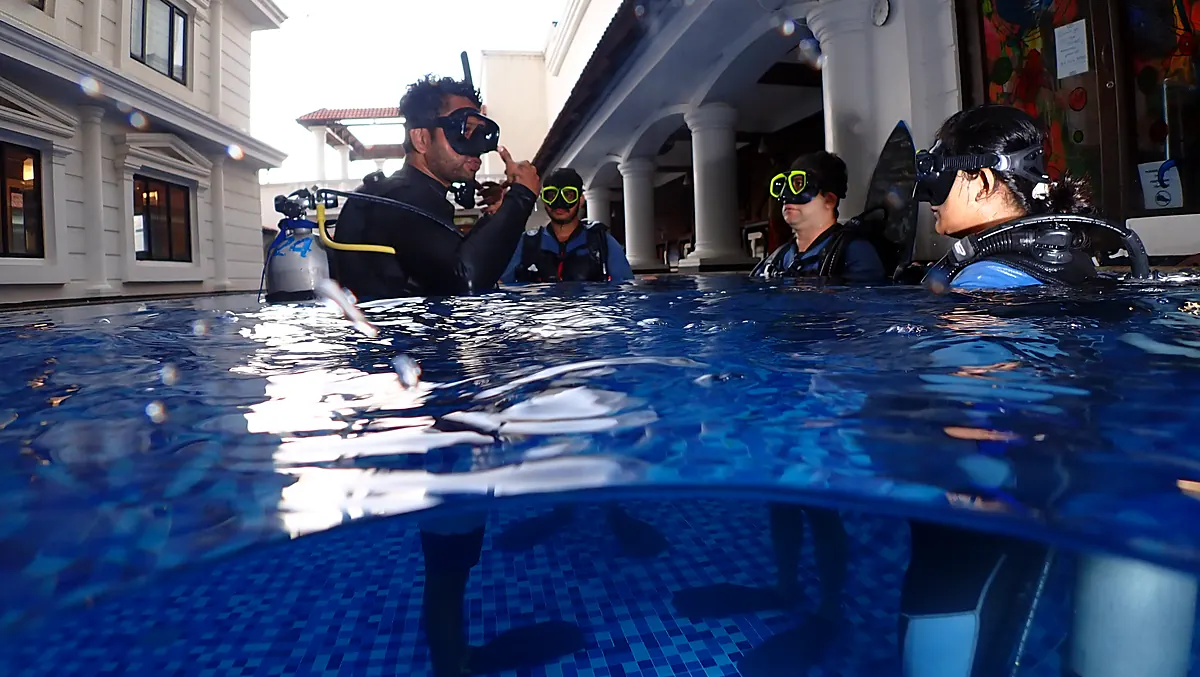
In about 45 minutes of shallow, calm pool water, your instructor teaches you the few skills a first ocean dive needs: breathing through the regulator, clearing water from your mask and equalising your ears. The pool session is mandatory. It is there so you arrive at the reef feeling at home, not learning under pressure.
Most pool sessions follow this order:
- You kneel or stand in shallow water, put your face in and take your first breaths from the regulator.
- Once that feels normal, you go fully under and simply breathe, watching your bubbles rise.
- You let a little water into your mask and learn to clear it by breathing out through your nose.
- You practise equalising your ears and the hand signals for "OK", "problem" and "up".
An honest note: some take to the water like fish, while others need time, patience and the right guidance. Needing more pool time is completely normal, and we only head to the harbour once you're confident and your instructor is satisfied with your comfort level.
What are the boat ride and the descent like?
After the pool, you make your way to the UNA Harbour, our private harbour, and board our boat to UNA Home Reef. On the way, your instructor helps you into your equipment and runs through the dive plan. At the reef, you enter the water with your instructor and go down slowly together, stopping whenever your ears need a moment.
You'll need your own transport to the harbour, and we're happy to connect you with local partners. If you tend to feel seasick, mention it when you book.
Will your ears hurt, and how do you equalise?
Your ears may feel pressure as you go down, much like on a plane landing, but they shouldn't hurt if you equalise early and often. Gently pinch your nose and breathe out softly against it, or swallow, every metre or so. If one ear won't clear, signal your instructor, rise a little and try again.
Never force it: pain means stop going down, not push harder. A blocked nose or heavy cold makes equalising much harder, so tell us if you're congested. Divers Alert Network (DAN) publishes dive health guidance if you'd like to read more.
How deep do you go on a first scuba dive?
On PADI Discover Scuba Diving, the maximum depth in the ocean is 12 metres (40 feet). That is a limit, not a target. You will not go any deeper than you feel comfortable with, and plenty of first-timers enjoy their whole dive shallower than that, among the fish in midwater.
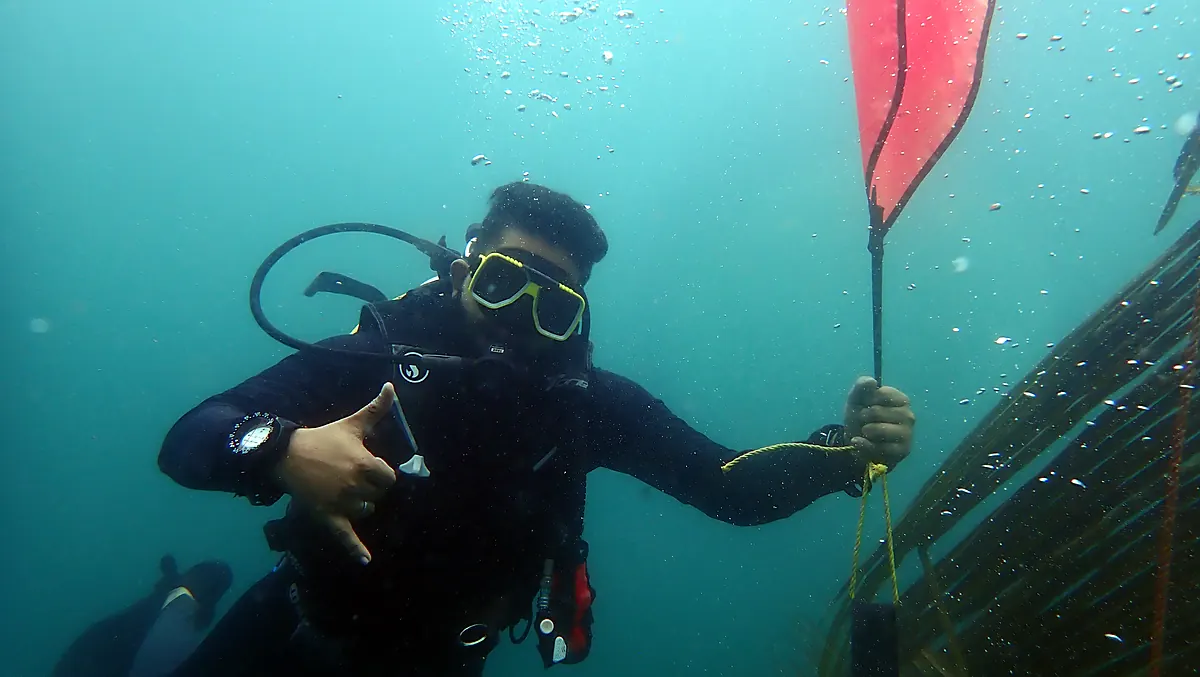
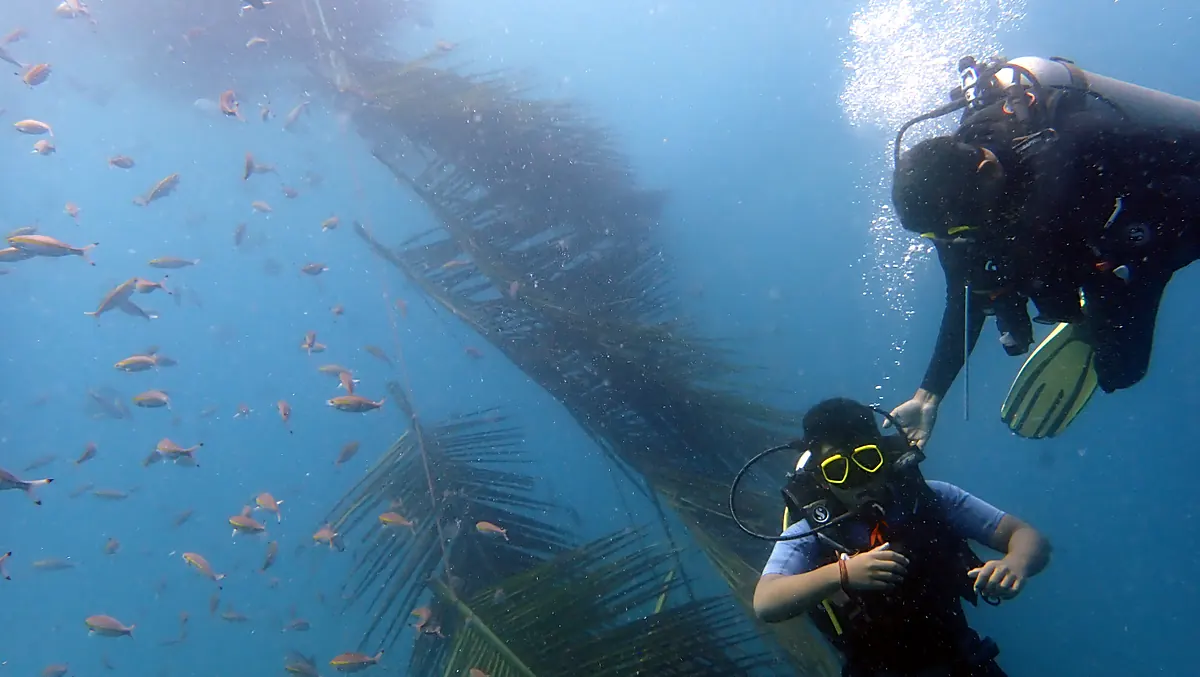
UNA Home Reef is built for exactly this. Lines anchored to the seabed hold coconut palm leaves upright from about 18 metres all the way to the surface, so you can stay at 12 metres or above and still be right among the marine life. Read how the reef works on the UNA Home Reef dive site page.
What does breathing underwater feel like?
For most people, the first breath underwater feels strange for a few seconds and then surprisingly ordinary. The air tastes dry, you hear yourself breathe and your bubbles rumble past your ears. The one rule that matters most is never to hold your breath. Breathe slowly and continuously, in and out, the whole time.
PADI lists this first among its golden rules of scuba diving, because the air in your lungs expands as you rise. Slow breathing also keeps you calm and makes your air last longer. Once you settle into it, the noise of the world seems to switch off.
What will you see on your first dive in Pondicherry?
At UNA Home Reef, schooling fish, barracudas and trevallies are common, and batfish, big schools of bigeye jacks and large groupers are regulars. In July and August, whale sharks sometimes pass by. Visibility ranges from about 5 to 15 metres, and what you see changes with the season and the day.
This is a big part of the case for a first dive in Pondicherry. The artificial reefs here work as fish aggregating devices, drawing many kinds of fish to an open seabed, and you dive in the real ocean from day one. Nothing is guaranteed, but if you're curious about the biggest visitor, read when whale sharks visit Pondicherry.
Is scuba diving scary the first time?
Feeling nervous before your first dive is completely normal. Most of the fear comes from not knowing what will happen. Once you've breathed underwater in the pool and practised each skill with your instructor, the ocean feels like the next small step rather than a leap.
We think of diving like walking down a road. A road isn't risk-free, but you use the footpath and follow a few simple rules. Diving's risks are well understood, and following your training keeps them low. As a PADI 5 Star Dive Resort, we follow PADI's standards on every dive: a full briefing, well-maintained equipment and a site chosen for the day's conditions. If you feel anxious at any point, just signal your instructor.
What happens after your first dive?
Back on the boat, you enjoy refreshments, look through your photos and videos, and receive your PADI Discover Scuba Diving participation certificate. Wait at least 12 hours before you fly. Remember that it is a one-time experience, not a certification, so it doesn't qualify you to dive on your own.
If you fall in love with it, here are your next steps:
- Within 14 days, you can make more ocean dives with us without repeating the pool training.
- If you can float but can't swim, the one-day scuba certification for non-swimmers makes you a PADI Scuba Diver for life, certified to 12 metres with a PADI professional.
- If you can swim, your trial dive can be credited towards the PADI Open Water Diver course, or you can do the whole course over a weekend with our weekend scuba classes.
A word on weather. From November to early February, cyclonic spells can stop boat trips, so check your dates with us before you plan around a dive. Our cancellation policy explains what happens if the weather changes. Prices and what's included are compared in our guide to scuba diving prices in Pondicherry.
Frequently asked questions
How deep do first-time scuba divers go?
On PADI Discover Scuba Diving, first-time divers go to a maximum of 12 metres (40 feet) in the ocean. You won't go any deeper than you feel comfortable with. At UNA Home Reef the palm-leaf lines rise to the surface, so you can stay shallower and still be among the fish.
Can I scuba dive if I can't swim?
Yes. PADI Discover Scuba Diving needs no swimming skills, and your instructor guides you step by step in the pool and the ocean. If you can float for 10 minutes and want a certification, the one-day PADI Scuba Diver course for non-swimmers has no swim test.
Is scuba diving scary for non-swimmers?
It can feel scary beforehand, and that's normal. You start in a shallow pool, learn one skill at a time with your instructor beside you, and only go to the ocean when you're both ready.
Why do my ears hurt when scuba diving?
Water pressure rises as you go down and pushes on your eardrums. Equalising, by gently breathing out against a pinched nose or swallowing, balances it. Equalise early and often, and if it hurts, stop, rise a little and try again. Never force it. A blocked nose makes it harder, so tell us if you have a cold.
Is scuba diving dangerous?
Diving has risks, like walking down a road, but they are well understood and kept low by following your training and a few simple rules: never hold your breath, go up slowly and stay within your limits. As a PADI 5 Star Dive Resort, we follow PADI's standards on every dive. Our FAQ page explains this in more detail.
Can I scuba dive if I wear glasses?
Yes. You can't wear glasses under a dive mask, but you can dive with soft contact lenses (check with your eye doctor first) or use one of our prescription masks, available from -3 to -7 power on request. Tell us about your eyesight when you book.
Your first breath underwater is waiting
For many people, the moment that stays with them comes a few seconds below the surface, when they realise they're breathing calmly and a school of fish drifts past as if they belong there. The team at Urban Nomad Adventure will take you there at your own pace.
Tell us your dates and how you feel about the water, and we'll help you plan your first dive. We'd love to welcome you to our ocean family.
About the reviewer
Hardik Datanwala is a PADI Course Director (PADI #298676) at Urban Nomad Adventure, training scuba instructors since 2017, and a two-time PADI Silver Course Director.
On 15 August 2026 he received the Lieutenant Governor's Commendation Award from the Lieutenant Governor of the Andaman & Nicobar Islands. In May 2026 he was part of the teams that set two Guinness World Records in the Andaman Islands, the largest flag unfurled underwater and the tallest human stack underwater (as Lead Diver), and he holds an individual certificate for each. More at hardikdatanwala.com.
Plan your first dive with us
WhatsApp us on +91 93852 30820 with your dates, or call +91 94296 90234. Prefer to read more first? Start with PADI Discover Scuba Diving.